


How top auction houses are saving 10+ hours per employee weekly through automation with Auction Management Software
February 25, 2026
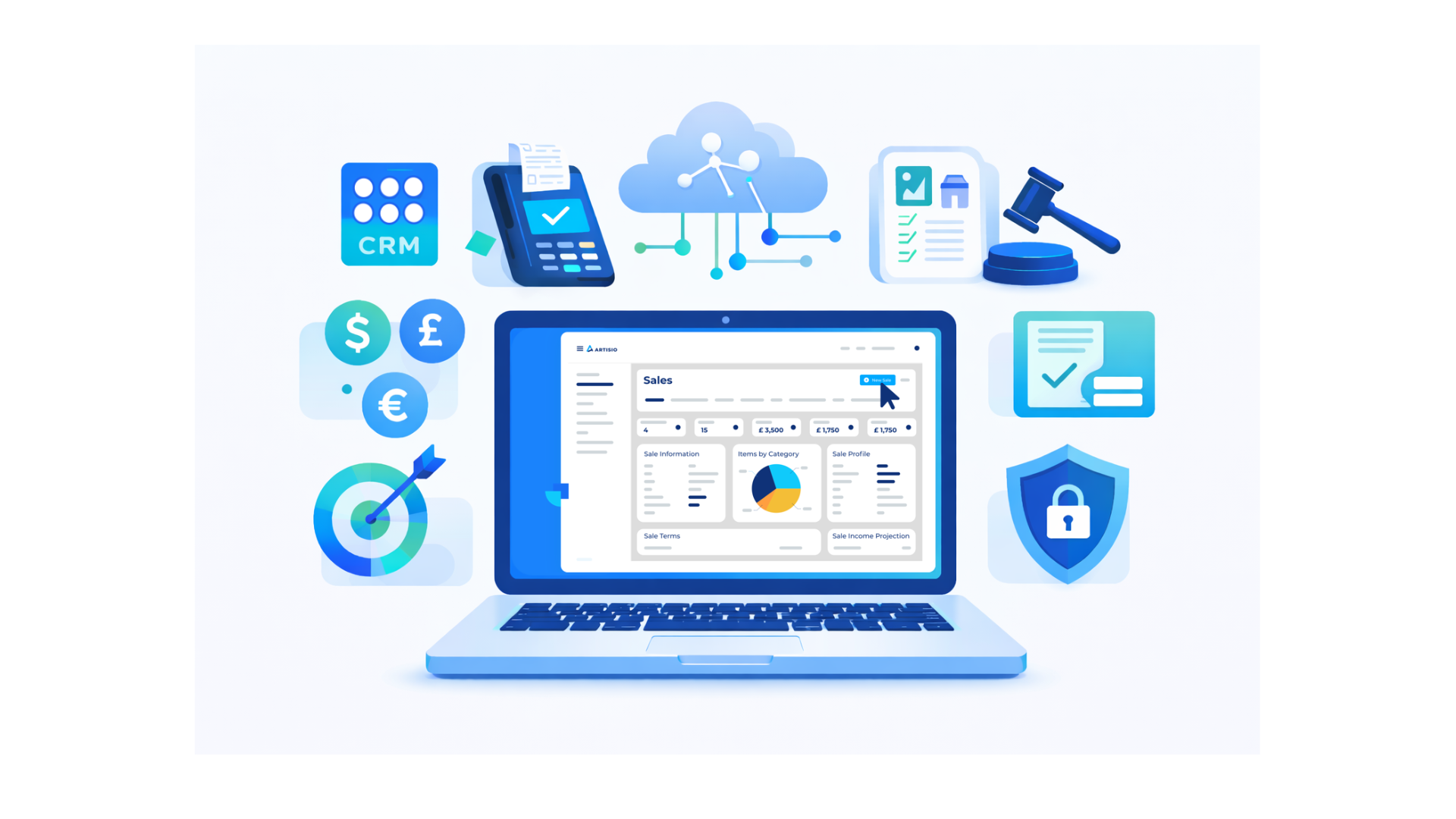
Leading auction houses are saving more than ten hours per employee each week by automating routine back-office tasks such as cataloguing, invoicing, payments, reporting and client management. By replacing manual processes with a centralised auction management platform, teams reduce admin time, improve accuracy and focus more on revenue-generating.
Time has become one of the most valuable assets in any business, and auction houses are no exception. But the time pressure isn't during the sale itself, it's in the hours spent cataloguing inventory, reconciling payments, updating client records, preparing reports and moving data between systems. These operational tasks are essential, yet they rarely create competitive advantage. They simply keep the business running.
Across the industry, leading auction businesses are now questioning how much of this work truly needs to be manual. The answer, increasingly, is very little.
By automating routine back-office processes and centralising their operations onto a single auction management platform, many businesses are reclaiming two or more hours per employee each day, totalling over ten hours a week per person. Over the course of a year, that equates to hundreds of hours redirected away from repetitive administration and towards activities that directly support revenue and client relationships.
For smaller teams, this can feel like adding another member of staff. For larger organisations, the cumulative impact is substantial.
Automation as an operational strategy
Auction houses across all verticals, whether specialising in fine art, collectibles, industrial and commercial assets, classic cars, or wine and whisky, share a similar operational reality. Every sale requires coordination across inventory, bidders, vendors, finance and customer service.
When those functions rely on spreadsheets, disconnected tools or duplicated data entry, time is lost in small increments throughout the day.
Individually, these tasks appear minor. Collectively, they slow the entire organisation.
The most efficient businesses have moved away from this fragmented approach and have embraced automation. Rather than asking staff to manage processes manually, they design workflows that run automatically in the background.
This shift is less about technology for its own sake and more about freeing skilled teams to focus on the work that actually drives growth.
How auction automation saves time
The hours saved are rarely the result of one dramatic change. Instead, they accumulate across everyday auction operations.
- Preparing catalogues becomes faster when lots can be uploaded in bulk or captured on the move, rather than entered one by one.
- Inventory tracking improves when QR-based identification replaces manual checks.
- Post-sale administration accelerates when invoices are generated automatically, and payments can be settled securely online without chasing buyers.
- Reporting becomes immediate when performance dashboards replace manual spreadsheet compilation.
- Client interactions are easier to manage when communication history and follow-ups are logged in one place rather than across emails and notes.
None of these improvements are revolutionary in isolation. Together, they remove a significant share of repetitive work from every employee’s day.
The result is measurable: less time spent on admin and more time available for catalogue curation, consignor relationships, marketing and sale strategy.
A practical example
This experience is reflected by established auction houses already operating at scale. For example, Venduehuis der Notarissen, based in The Hague, has highlighted how automating everyday back-office processes with Artisio helped make operations more seamless and streamlined, enhancing productivity, freeing staff time and improving customer service by removing manual tasks and reducing the risk of human error. You can read more about their case study here.
Their experience mirrors what many others report: when routine processes are automated, teams become more responsive, and the overall quality of service improves.
Importantly, these gains are not limited to one segment of the market. The same principles apply whether managing high-value art sales or high-volume commercial auctions.
From efficiency to competitive advantage
Saving ten hours per week is not simply an efficiency metric. It changes how an auction house operates.
When staff are not tied up reconciling invoices or compiling reports, they can spend more time building relationships with buyers and vendors, improving catalogue quality, and identifying new opportunities.
Decisions are made faster because cloud-based information is available in real time. Teams collaborate more effectively because everyone works from the same data.
In a market where client experience and speed increasingly differentiate one house from another, these operational improvements translate directly into commercial results.
The role of a centralised auction management platform
Delivering this level of automation requires more than isolated tools. It depends on a fully integrated system where inventory management, bidding, payments, reporting and client management work together seamlessly. And this is the approach behind Artisio.
As a complete auction management software and online bidding platform, Artisio automates the processes that traditionally consume the most time and centralises every workflow into one environment.
Instead of adding more tools or headcount, auction houses using Artisio auction software can simplify their operations and give their teams the clarity and capacity to focus on growth.
It is why Artisio is the ultimate engine for your auction business: the technology runs in the background so your people can concentrate on delivering exceptional auctions.
A smarter way to grow
For many auction houses, growth has historically meant hiring more staff to handle increasing workload. Automation offers a different path, scaling output without scaling administration.
By removing hours of repetitive work each week, teams become more productive, more strategic and better equipped to serve clients.
The outcome is straightforward: tighter operations, stronger customer relationships, and more time invested where it matters most.
And for businesses competing in today’s auction market, that reclaimed time is often the difference between simply keeping up and moving ahead.
